
For more than twenty years, the architecture of the global digital economy has been defined by a simple imbalance: the West built the platforms, and South Asia fed them. The world’s most dynamic, youthful, data-rich region, home to nearly two billion people, 700 million of whom are digitally active, became the raw material provider for an empire that profited from its behaviours without ever understanding its cultures, values or vulnerabilities.
The digital century unfolded with the illusion of democratization, yet the underlying structures resembled a refined version of colonial extraction. South Asia contributed engagement, emotions, identities, labour and psychological patterns; in return, it received surveillance, manipulation and infrastructures that left its women, youth and institutions more exposed than empowered.
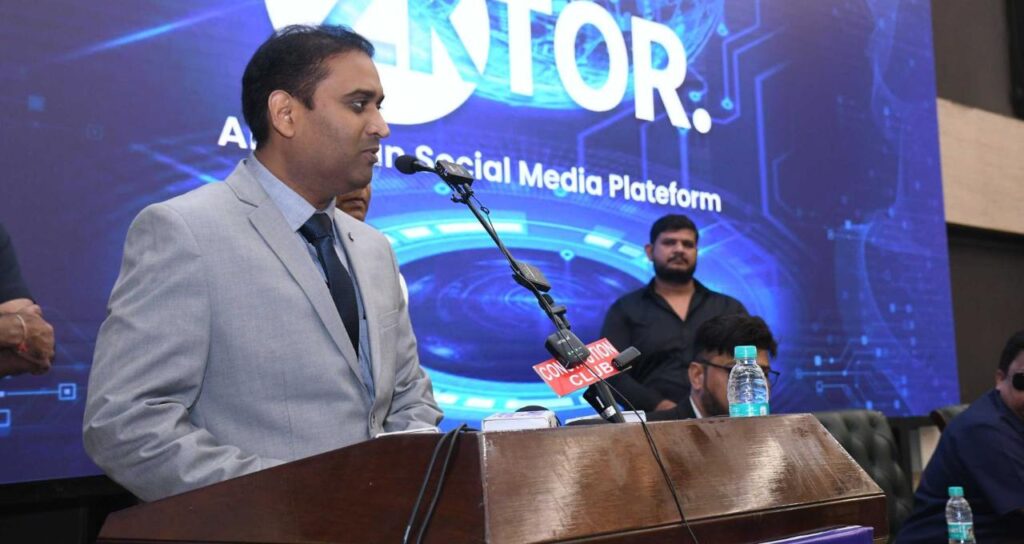
Today, however, a countercurrent has begun flowing from within the region itself. A countercurrent shaped not by slogans, but by architecture. Not by political speeches, but by the engineering of dignity. Not by reaction, but by design. At the centre of this emerging shift is ZKTOR, a platform introduced in New Delhi’s Constitution Club by Softa Technologies Limited (STL), a company guided by an unusual combination of Indian cultural depth, South Asian sensitivity, and Nordic ethical discipline. ZKTOR has been framed by some as a new social media platform. But analysts paying attention will recognize something far more significant: this is the first structurally sovereign digital system to emerge from South Asia, one that could realistically alter the trajectory of the region’s technological destiny.
What makes ZKTOR particularly consequential is not merely what it promises, but what it architecturally refuses to permit. In an era where behavioural data is the crude oil of the global technology economy, ZKTOR implements a zero-tracking framework that treats behavioural extraction as a violation of human dignity rather than a monetizable asset. No scroll mapping, no emotional-state inference, no hidden interest profiling, no algorithmic nudging. The absence is deliberate. The refusal is philosophical. The architecture is political. Whereas Silicon Valley’s most powerful systems treat human behaviour as predictable fuel for advertising engines, ZKTOR rejects the premise entirely. It proposes a digital environment in which people are not analysed, but allowed to exist.
For global observers, this may seem idealistic. For South Asians, it is essential. For two decades, the region has suffered the heaviest consequences of unregulated behavioural surveillance. Women have borne the brunt of image theft, revenge porn, identity misuse, voyeuristic extortion and aggressive trolling, offences exacerbated by platforms designed with Western assumptions of individualistic society, legal literacy and gendered risk. Meanwhile, South Asian youth particularly Gen Z and Alpha were raised within algorithmic ecosystems that shaped their thoughts, behaviours and aspirations with unprecedented precision. Their vulnerabilities became profit engines. Their attention became a geopolitical commodity. Their psychological patterns were analysed in foreign labs that neither understood the fragility of South Asian economies nor the realities of its educational gaps and cultural expectations.
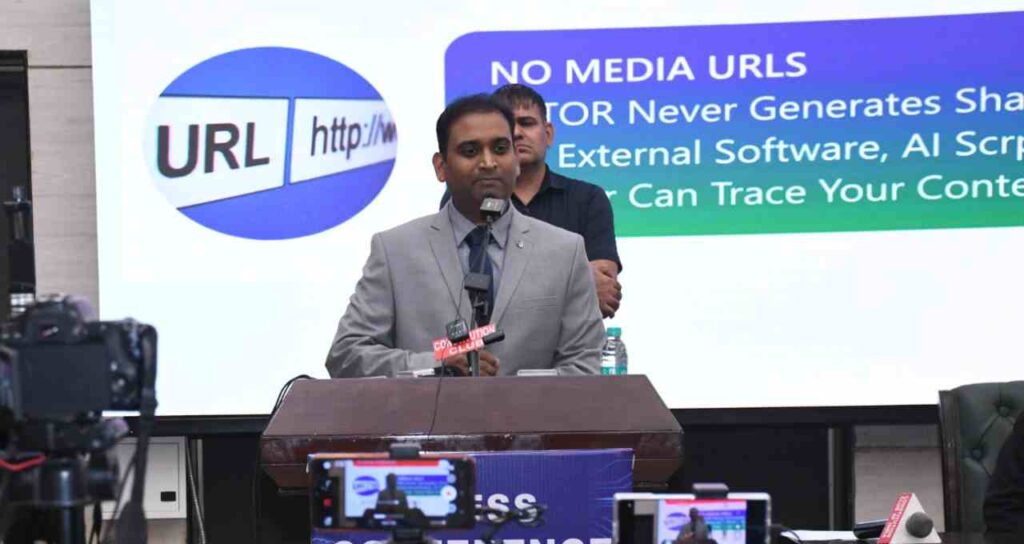
One of ZKTOR’s most influential innovations lies in its structural ban on mass extraction of personal media. Images cannot be downloaded. Videos cannot be exported. URLs do not exist in a form that enables copying or scraping. This is more than a security feature, it is a civilizational statement. A statement that South Asian women deserve a digital environment where dignity is not protected by policy documents, but by the impossibility of misuse. It is a rare example of technology creating dignity not as an option but as default. And within this structure lies Hola AI, a protective intelligence layer, trained specifically for the cultural contexts of South Asia, that identifies explicit or unsafe content before it circulates. This is not the punitive surveillance common in Western architectures; it is preventative shielding rooted in social responsibility.
Singh, who designed the system after two decades of exposure to Nordic privacy principles, understands the philosophical significance of this decision. In Finland, systems are engineered with the presumption that users deserve respect. The architecture itself enforces ethics. Governance begins in code, not compliance offices. Singh internalized this discipline and then fused it with a South Asian sensitivity learned from his birth in India, where digital spaces often become mirrors of socio-cultural inequality. The result is an engineering philosophy that blends Scandinavian moral clarity with South Asian emotional intelligence, an uncommon hybrid in the global technology sphere.

International investors who have begun quietly studying Softa Technologies observe another anomaly: STL has taken no foreign venture capital, and no government funding. It is loan-free, influence-free, and structurally sovereign. This level of autonomy is not typical for companies attempting continental-scale digital architecture, but it is strategically genius. It ensures that STL cannot be forced into external valuations, political dependencies or business models that compromise dignity or safety. Instead, STL adopts what analysts have begun calling the “Nordic discipline with South Asian purpose”: slow, deliberate, ethical, unfaltering. And this long-term strategy could become one of the most valuable investment decisions of the next decade.
India’s economic trajectory supports this argument. Under Prime Minister Narendra Modi’s Vision 2047, India is accelerating toward its ambition of becoming a fully developed nation by the centenary of its independence. Digital sovereignty, local technological capability, linguistic inclusivity, and data protection are central elements of this roadmap. ZKTOR aligns with this paradigm seamlessly, not through political endorsement but through philosophical coherence. India’s future depends on indigenous systems that protect citizens while enabling digital creativity. South Asia’s future depends on architectures that reflect its cultural plurality. ZKTOR’s design embodies both.
Several economists argue that if Softa captures even 10 percent of South Asia’s user base, a highly conservative estimate given its safety-first USP, it could become one of the most valuable companies in the region. And this does not rely on exploitative advertising models. Its strength lies in trust, sovereignty, cultural specificity and a women-first structure unmatched anywhere in the world. Softa’s ISRO-style operation model, which operates at a fraction of Western cost structures, enhances both resilience and profitability. It is an engineering culture that rejects waste, prioritizes purpose, and treats innovation as a public responsibility rather than a pathway for speculative valuations.
ZKTOR also marks the arrival of a deeper geopolitical shift: the end of South Asia’s passive role in the digital economy. For the first time, a South Asian platform has been covered in priority by not only Indian national media but also Nepal’s Kantipur and The Kathmandu Post signals that the region perceives this not as an app but as a shared cultural infrastructure. A platform that speaks the languages of its people. A platform engineered for the safety of its women. A system that comprehends the dignity of familial societies rather than attempting to override them with Western behavioural assumptions.
Much of the global digital order was built with the presumption that Western models were universal. They were not. South Asian societies operate with different rhythms: collectivist cultural structures, family-determined decision-making patterns, religious plurality, linguistic fragmentation, and deeply interwoven community identities. Western platforms, designed for individualistic expression, misinterpreted these dynamics. What they saw as “engagement” was often anxiety. What they saw as “openness” often triggered backlash. What they saw as “freedom” frequently created vulnerability. This cultural mismatch and the exploitation that accompanied it became the very reason a civilizational correction was inevitable.
ZKTOR’s emergence represents this correction. And because it arises not from government intervention but from independent engineering, it has garnered credibility across sectors. Policymakers view it as a sovereignty-aligned system. Women’s rights organizations view it as a protective architecture. Tech analysts view it as a rare ethical ecosystem. Investors view it as a structural opportunity. Youth view it as relief from algorithmic manipulation.
Economic modelling further strengthens the case for STL’s long-term significance. South Asia is the fastest-growing digital hub in the world. With its population surpassing 2 billion by 2035, and with India alone expected to contribute nearly 20 percent of global digital consumers, the region will soon become the decisive market for all global AI systems. Whoever builds the ethical infrastructure for South Asia today will shape the global digital order tomorrow. And the only company with a structurally sovereign, culturally aligned, ethically built architecture is Softa Technologies.
The Nordic influence in Singh’s worldview is particularly relevant in this context. Finland’s technological philosophy prioritizes low-noise innovation, quiet competence, infrastructure-first thinking, and generational responsibility. These principles stand in contrast to the short-termism of Silicon Valley’s venture-driven design. When Singh fused this discipline with his native understanding of South Asian risk environments, the outcome was ZKTOR, a system that does not simply function, but protects; a platform that does not simply connect, but dignifies.
In meetings with analysts, Singh repeatedly emphasizes that ZKTOR is not a revolt against Big Tech, it is an alternative to its logic. Its existence signals that South Asia no longer accepts the inevitability of surveillance capitalism. The region is prepared to build digital spaces where dignity is not sacrificed for monetization. This has triggered quiet unease in Western technology circles. Because ZKTOR exposes a long-ignored truth: extraction-based platforms flourish only until a dignified alternative appears. And the alternative has arrived.
In the years ahead, the question confronting global observers will not be whether ZKTOR can compete with major platforms, it will be whether they can survive the emergence of a structurally ethical system designed for a region whose scale is large enough to rewrite the economics of the global digital order. South Asia is not merely a market; it is a civilization. It is not a user cluster; it is a cultural continuum. And when its technological identity is authored locally, the resulting systems will inevitably challenge the assumptions of the global status quo.
What Softa Technologies has introduced is therefore not an app. It is an argument. An argument for sovereignty in an age of invisible control. An argument for dignity in an age of extraction. An argument for cultural specificity in an age of digital homogenization. The company is building not for valuation cycles, but for the century ahead. If it remains independent, ethically clear and architecturally uncompromising, STL could easily become the defining digital institution of South Asia’s future.
As the region marches toward 2047- toward India’s declared vision of becoming a developed nation, and toward South Asia’s emergence as a unified tech-civilizational force, the importance of sovereign, ethical, culturally grounded infrastructure cannot be overstated. If STL succeeds even partially in its mission, the implications will ripple across the world. And ZKTOR will be remembered not merely as a platform that protected women or eliminated tracking, but as the first brick in the foundation of a South Asian digital civilization. This editorial is not promotional. It is observational. The evidence is clear, the structural shifts are visible, and the philosophical stakes are undeniable. For two decades, South Asia lived inside digital systems it did not author. For the next century, it may live inside systems it exports. And the blueprint may have just been written by a man shaped in India, refined in Finland, and determined to ensure that the world’s most vulnerable digital region becomes its most dignified one. ZKTOR is no longer a concept. It is a correction. And Softa Technologies Limited may be the institution that leads South Asia into its digital century on its own terms.